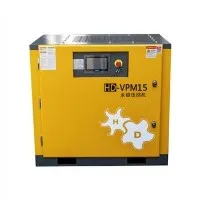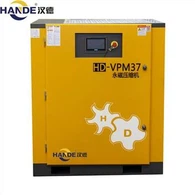


| Model | HD-VPM22 | ||
| Working pressure: | 8bar | 10bar | 12bar |
| Air Delivery (m³/min) | 3.6 | 3.2 | 2.7 |
| Air Delivery (CFM) | 127 | 113 | 95 |
| Motor power | 22KW/30HP | ||
| Power voltage: | 380V/50hz/3phase (different voltage is available) | ||
| Compressor type: | Permanent Magnet Variable Frequency Screw Air Compressor | ||
| Cooling Mode | Air cooling | ||
| Starting mode | Variable Frequency Start | ||
| Ambient temperature | -5℃ ~ +45℃ | ||
| Discharge temperature | ≤ Ambient temperature+15℃ | ||
| Dimension (mm) | 1080*850*1200 | ||
| Product display: |


| Product advantage: |
1.Direct drive via flexible coupling.
2.Fully encapsulated CROWNWELL screw compressor block.
3.Standard electric motor Protection Index IP23 and IP54.
4.User friendly service access.
5.Top quality, washable, oil resistant sound insulation.
6.Ready for operation, prewired and fully enclosed.
7.With operating mode selector switch Automatic-Off-Continuous.
8.Centrally mounted cooling fan provided for compressed air and lubricant coolers.
9.Compact and neat cabinet design.
Lubricating oil has a decisive influence on the performance of oil-injected screw compressors. If used improperly or incorrectly, it will cause serious damage to the Oil Separator Compressor body. The lubricating oil must be replaced in time, otherwise the quality of the oil will drop and the lubrication performance will be poor, which will easily cause tripping due to high temperature. At the same time, because the ignition point of the oil will drop, it will also cause the spontaneous combustion of the oil to cause the air compressor to burn out.
The oil should be changed when the following changes occur in the lubricating oil:
1. The water content is greater than 0.1%;
2. The acid value is greater than 2mg KOH/g;
3. Kinematic viscosity Bo Anhua exceeds 10% of the allowable value;
4. The color changes to brown-black.
The oil should be changed after the unit is still hot and the oil and gas separator is depressurized, and the oil in the oil and gas separator should be drained first, and then new oil should be injected into the oil and gas separator. When the oil level of the level gauge is higher than 70, tighten it. Fuel plug. Be careful not to inject too much oil, otherwise the excess oil will be carried away by air. The oil filter should be changed at the same time when changing the oil. When replacing the oil filter, apply a layer of oil on the rubber sealing ring of the new oil filter and tighten it. Generally, mineral-type lubrication has to change the oil after accumulative operation for 2500h, but if the operation is less than 2500h in a year, the oil must be changed after one year. The lubricating oil should be discharged immediately after the compressor is stopped, so that the tiny particles suspended in the oil can be discharged out of the machine along with the lubricating oil.
Note: For the maintenance details of the Oil Separator Compressor, please carefully read the random operation manual. Analysis of common failures of screw air compressors and treatment. Once the compressor fails, you have a relatively familiar understanding of the principle and structure of the compressor, then the cause of the failure Analysis and elimination are not difficult. The analysis of failures should start from the easiest and most convenient place. The following describes the analysis and treatment methods of several common faults.
The compressor is not loaded:
1) The pressure on the gas pipeline exceeds the rated load pressure, and the pressure regulator is disconnected. There is no need to take measures. When the pressure on the gas pipeline is lower than the pressure regulator loading (position) pressure, the compressor will automatically load;
2) The solenoid valve is out of order, remove it for inspection, and replace it if necessary;
3) There is a leak in the control pipeline between the oil and gas separator and the unloading valve. Check the pipeline and connections. If there is a leak, repair it.
1) Check whether the two-position manual valves and pressure gauges "before separation" and "after separation" are leaking. If there is a leak, troubleshoot the leak or replace the manual valve:
2) Check whether the regulating solenoid valve is leaking. If it leaks, remove the cause and replace the regulating solenoid valve if necessary:
3) If the air consumption exceeds the exhaust volume, check the pipeline for leakage. If there is, remove the leak or reduce the air consumption:
4) Check whether the air filter element is blocked, clean or replace if necessary:
5) Check whether the safety valve is leaking. If the gas leaks out, it should be removed and replaced if necessary:
6) Check whether the butterfly valve is fully opened and whether the intake regulator is working normally. If there is any problem, replace or re-adjust the pressure switch: Check whether the upper and lower limits of the pressure switch are normal, and adjust if necessary:
7) If the compressor fails, contact the manufacturer and check the compressor after consultation.
Exhaust pressure is too high:
1) Check the butterfly valve mechanism for mechanical failures, if so, remove the failures:
2) Check whether the solenoid valve is leaking. If it leaks, remove the fault and replace the solenoid valve if necessary:
3) Check and adjust the upper and lower limits of the pressure switch, and replace the pressure switch if necessary,
Exhaust temperature is too high:
1) Check whether the exhaust pressure exceeds the regulation, if it exceeds, it should be adjusted to the specified exhaust pressure:
2) Check whether the lubricating oil is clean and the oil level is normal. If necessary, make up or replace the lubricating oil:
3) Check whether the speed of the fan motor is normal and whether the exhaust port is properly trained:
4) Check whether the outer surface of the oil cooler and aftercooler are clean, and clean the outer surface of the cooler if necessary:
5) Check whether the environment has any influence on the air intake and exhaust of the unit. If so, remove the influence of external factors to ensure that the unit has normal ventilation:
6) Check whether the temperature control valve is damaged: Check whether the solenoid valve solenoid wire and solenoid valve diaphragm are damaged, repair or replace if necessary;
7) Check whether the oil-air separator filter element is blocked or the resistance is too large, if so, replace the oil filter element.
The compressor consumes a lot of fuel:
1) Whether the oil content of the condensate discharged by the trap is large, if it is large, check the leak points in the unit and drain it.
except;
2) Check whether the compressor oil level is too high, if it is high, lower the oil level;
3) Check whether the opening pressure of the pressure valve is normal, and if necessary, check and replace the valve;
4) Check whether the oil return pipe is blocked, and clean or replace the oil return pipe if necessary;
5) Check whether the oil separator filter element is invalid, and replace the oil separator filter element if necessary.
The Oil Separator Compressor does not supply air:
1) Check whether the control cylinder is moving, and check whether the butterfly valve has mechanical failure;
2) Check whether the loading electromagnetic coil has suction;
3) Check the sub-circuits where the solenoid valve is located one by one.
The compressor cannot be started:
1) Check whether there is a control voltage, if not, check whether the fuse is intact;
2) Check whether the control relay and time relay are operating normally.
The compressor is running normally, and it is difficult to start after stopping:
1) The lubricating oil used is of the wrong brand, and the oil should be changed thoroughly after cleaning;
2) The oil is sticky and coking, and the oil should be changed thoroughly after cleaning;
3) The shaft seal is seriously leaking, remove it and replace it;
4) The original position of the unloading valve flap is changed, and the position is readjusted.
The compressor does not start smoothly, and it will automatically stop after a few seconds after starting:
1) Check whether the automatic air switch has taken off and whether the voltage is normal, which should be ruled out;
2) Whether the closing degree of the intake butterfly valve is normal, it should be checked, and it needs to be re-adjusted or replaced;
3) Check whether the three phases of the contactor and the motor are normal during Y-▲ startup.
| Company introduction |

| Production Capability |

| Corporate Qualifications |


| Global exhibition & Training |

| Packing and delivery |

Hot Tags: oil separator compressor, China, manufacturers, suppliers, factory, customized, wholesale, in stock, Variable Frequency Direct Driven Screw Compressor, Frequency Air Compressor, VFD Screw Compressor 37kw, 10bar Vsd Screw Air Compressor, VFD Three phase Motor Compressor, Direct Driving Screw Air Compressor